
Ultra-processed foods (UPFs) are products made from chemicals, flavorings, and refined ingredients rather than actual food. They show up everywhere: in the ‘organic’ aisle, in TV ads, in the office snack cabinet, and even in parenting magazines as “healthy snacks” for toddlers.
The challenge is that these products often look healthier than they really are. Labels may hide problematic ingredients. Packaging may overpromise on “nutrition values.” Marketing uses inflated health claims that sound reassuring but don’t tell the full story.
Once you know what to look for, UPFs become surprisingly easy to spot. Learning how to identify ultra-processed foods doesn’t require a nutrition degree or hours of research—just a few quick cues you can use right in the aisle.
Quick overview (TL;DR):
Here are fast indicators that you may be looking at an ultra‑processed food:
- Long ingredient list? More than 5–6 items is usually a red flag for UPF.
- Grandma test. If she wouldn’t recognize the ingredient, think twice before buying.
- Health halos. Buzzwords like “High Protein” or “Zero Sugar” often mask heavy processing.
- Odd additives. If you wouldn’t cook with it (gums, stabilizers, dyes), it’s probably UPF.
- Added sugars. Scan for sweeteners disguised as dextrose, syrups, or “juice concentrates.”
- “Natural flavors” claims. This term hides a lab-made blend of undisclosed chemicals.
- Flashy packaging. When the box relies on mascots, bright colors, or big claims to sell you, it’s often an ultra-processed product.
Seven proven ways to identify ultra-processed foods
Not sure whether something on the shelf is actually healthy food or just engineered to look like it?
Ultra-processed products have giveaways — on the label, in the ingredients list, even in the way they’re marketed.
These seven tips will teach you how to identify ultra-processed foods quickly while shopping.
1. Check the length of the ingredients list
If you need more than five seconds to read the ingredient list, it’s a good time to be suspicious. A short, simple list usually means nutritional, natural food.
Once you’re staring at more than five or six ingredients, especially ones that read like lab inventory, you’re likely dealing with an ultra-processed product.
2. Ask “Would my grandma recognize this ingredient?”
This question is a simple gut check for anyone who doesn’t want to decode labels. If the ingredient sounds like something your grandma cooked with — milk, eggs, butter, honey — you’re making a good choice.
But if it sounds like something she’d raise an eyebrow at, odds are you’re looking at a modern ultra-processed food dressed up as “healthy.”
Think ultra-high-protein milk, zero-sugar flavored yogurts, plant-based milks with long ingredient lists, fake meats, protein shakes, or oat milks that somehow have more “vanilla” than oats.
Speaking of the labels…
3. Train yourself to recognize health halo labels
A health halo label is any claim that makes a product look wholesome while distracting you from what’s actually inside.
Food companies know most shoppers skim. So they put big claims on the front of the package — High Protein, Zero Sugar, Keto, Gluten-Free, Made with Whole Grains, Fortified with Vitamins — to capture your attention.
But the actual product may be made with the same ultra-processed ingredients as everything else on the shelf — and cost more to boot.
A simple example makes the trick clear:
- A real apple delivers fiber, hydration, and nutrients in their natural form. It’s a great snack to give to your kid and munch on yourself.
- An apple-flavored vitamin gummy flashes “Made with Real Fruit” or “Fortified with Vitamins”. But it’s still mostly sugar, gel, stabilizers, and flavoring dressed up as produce.
The effects of the health halo labels are very strong.
In a recent study, consumers evaluated 20 products, labeled either “organic” or conventional. The “organic” label alone made people underestimate calories in high-calorie foods and overestimate calories in low-calorie foods. Even more interesting: people who regularly read nutrition labels were more vulnerable to this halo effect, not less.
The bottom line:
Trust what’s in the ingredients list, not the marketing on the front.
4. Scan for additives you wouldn’t use at home
Foods that contain ingredients that you wouldn’t stock in your own kitchen are usually ultra-processed. Think of anything with loads of thickeners, sweeteners, preservatives, and colourants.
Additives that often signal a food is ultra-processed
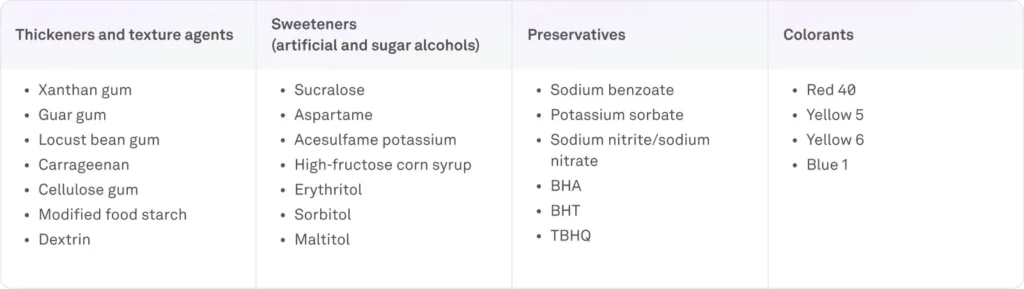
This stuff keeps factory-made foods shelf-stable, hyper-palatable, and miles away from “real.” Some of these ingredients can also undermine your health when consumed in high quantities over the long term.
5. Pay attention to sugars hiding under fake names
A lot of common ultra-processed foods are engineered around the bliss point — the precise mix of sugar, salt, and fat that keeps you reaching for another bite. It also rewires your palate so everything starts to taste like it should be sweet, even when it shouldn’t.
Food companies lean on our sugar cravings as a built-in marketing tool and slip added sugars into products wherever possible. But because “sugar” on a label is a dealbreaker for many shoppers, they often repackage it under friendlier-sounding names.
Common sugar aliases to watch for:
- Dextrose
- Fructose syrup
- Glucose syrup
- Cane crystals
- Brown rice syrup
- Malt syrup
- Agave nectar
- Barley malt
- Invert sugar
- Fruit juice concentrate
If the ingredients list includes multiple sweeteners or disguised sugars, it’s probably not a healthy choice.
6. Check for flavors — natural and artificial
During ultra-processing, food loses much of its natural flavor. To bring that taste back, companies add flavor mixtures. These flavor mixtures can contain over 100 added chemicals: solvents, emulsifiers, flavor enhancers, and preservatives.
And food companies aren’t obliged to disclose them on the label because of the legal loophole. The 1958 Food, Drug, and Cosmetic Act created a special category called GRAS (“generally recognized as safe”) substances.
It allows manufacturers to use two vague terms — natural flavors or artificial flavors — instead of disclosing the whole ingredients list.
As a result, of roughly 10,000 chemicals that can show up in our food or packaging, more than 3,000 have never been meaningfully reviewed by the Food and Drug Administration.
As a consumer, you have no idea how many chemicals you’re actually getting or what they are. So when you see “natural flavors,” you’re actually getting a lab-built flavor mixture, not ingredients found in nature. Like a “strawberry-flavored” yogurt made with exactly zero strawberries.
All of this adds up to a simple point:
Flavorings can mask what’s missing in the food, and they may also bring risks we still don’t fully understand.
7. Loud packaging usually means ultra-processed
Ultra-processed foods rely heavily on visual marketing cues to get your attention on the aisle. Bright colors, oversized claims, cartoon mascots, “high-protein” candy bars, kid-targeted cereals, vitamin gummies, and “healthy” chips are all designed to signal fun, convenience, or wellness — while distracting you from what’s actually inside.
And it works. An analysis of supermarket print marketing found that highly processed foods dominate weekly promotional placements.
These products are also aggressively marketed to parents and children. Another study showed a sharp rise in sugar sold through infant and toddler foods, jumping from 697 billion grams in 2010 to over 1,009 billion grams in 2021.
The rule of thumb:
If the packaging is shouting at you, charming you, or trying a little too hard to feel healthy, it’s probably ultra-processed.
Don’t let the marketing decide for you.
Now you know how to identify ultra-processed foods—even when the label is designed to mislead.
How to gently cut down on ultra-processed foods
Cutting out UPFs entirely isn’t realistic for most people — and it doesn’t need to be the goal. These products are everywhere, and they’re made for convenience.
You should go one step at a time. Swap one staple for a healthier alternative at a time.
- Sweetened yogurt cups → plain Greek yogurt with berries
- Boxed mac & cheese → wholegrain pasta and real grated cheese
- Soda and iced teas → homemade infusions with some fruit
- Frozen TV dinners → frozen or fresh fish steaks and veggies
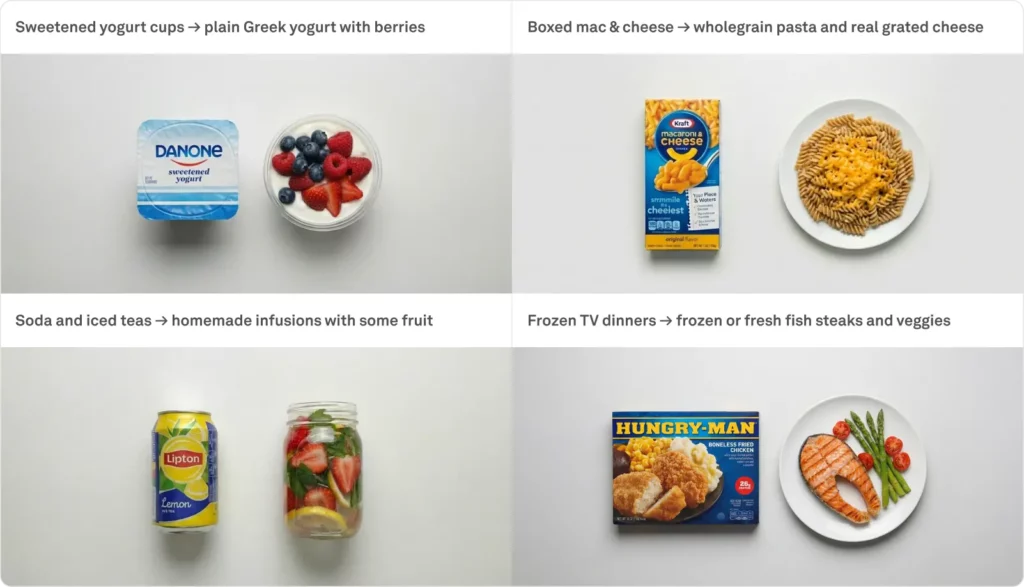
Try this simple rule: Add one nutrient-dense food before you try to cut two processed favorites.
Consistent, low-effort changes add up fast and make it far easier to eat in a way that supports long-term health.
This article is for educational purposes only and does not constitute medical advice. Individual nutritional needs vary. Please consult a qualified healthcare professional for personalized guidance.