
Food companies make it hard to question what’s in our meals, dressing up ultra-processed foods with reassuring labels.
Our smoothies may be spiked with added sweeteners. We grab a “healthy” granola bar as a mid-day snack, or use a ready-made sauce to add more flavors to home-cooked dishes.
But behind the convenience hides some real danger.
Our foods have drifted far away from being natural. Much of what ends up on our plates today are ultra-processed foods, affordable and heavily marketed, unlike healthier options.
What are Ultra-Processed Foods?
Ultra-processed foods (UPFs) are products, chock-full of additives that recreate the taste and feel of natural foods.
These include flavor enhancers, emulsifiers, and preservatives. They make inexpensive, often artificial ingredients taste better and stay fresher for longer. But additives also replace the essential nutrients our bodies need.
Compare two breads:

A traditional baguette stays fresh for a day. But its supermarket version can last for weeks, thanks to added industrial ingredients.
According to the U.S. Centers for Disease Control and Prevention (CDC), the average American now gets 55% of their daily calorie intake from UPFs. The most common examples of ultra-processed foods include:
- Processed meats
- Frozen and instant meals
- Savory packaged snacks
- Sauces and dressings
- Candies, cookies, confectionery
- Soft drinks and juices
- Ice cream and sorbets
- Vegan “meat” and “cheese”
Many of these meals are marketed as “quick,” “healthy,” or “wholesome,” despite being anything but that. And as consumers, we often have trouble telling them apart.
Read more: Top 10 Worst Ultra-Processed Foods in the American Diet
What Makes a Food “Ultra-Processed”?
Knowing what foods are ultra-processed is the first step. But what makes them “ultra-processed”?
Many of us eat a mix of raw or lightly processed foods, like fruits, vegetables, and nuts. We also enjoy items like yogurt or packaged meat, which have gone through safe processing.
The difference between healthy and not-so-processed goods lies in how far the processing goes for each item.
The more steps a food undergoes — both physical and chemical — before reaching the shelf, the more its original qualities change. Manufacturers replace original nutrients with cheaper, synthetic alternatives. They also add artificial ingredients that restore flavor, texture, and color, lost during reformulation.
What comes out in the end is ultra-processed food. The reformulated product may look like a “natural” option, but it lacks original nutrients.
To make the distinction clear, a team of Brazilian researchers created the NOVA food classification system. It’s now used worldwide by nutrition experts and public health authorities to help people understand what foods are ultra-processed and how to make healthier choices.
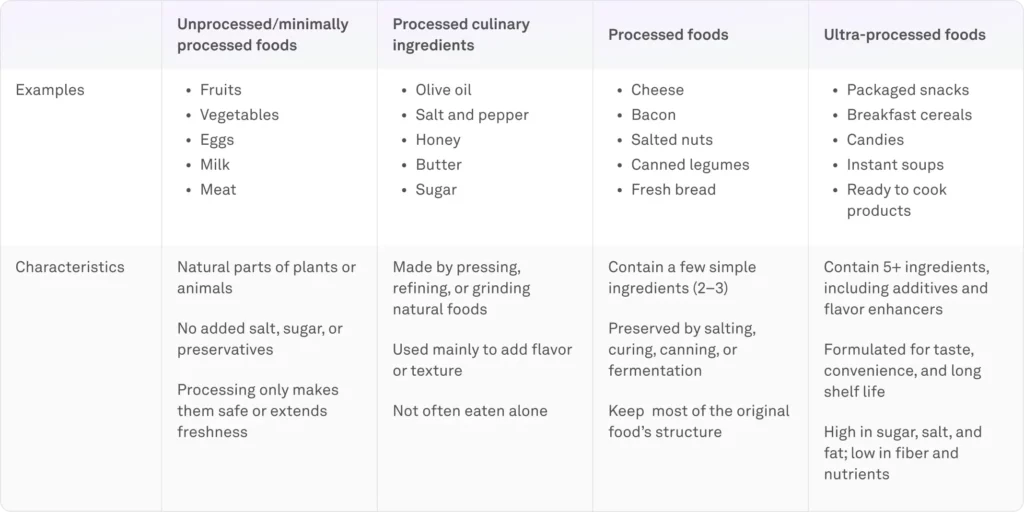
Source: Nova food classification system
Why Are Ultra-processed Foods Bad For You?
An occasional snack is unlikely to harm your health. But a diet, mostly containing UPFs, will take a toll on your body.
In a comparative study, people on a UPF-heavy diet consumed 500 more calories per day and gained almost two pounds in two weeks. Those who ate only minimally processed foods lost the same amount of weight.
But weight gain is the “lesser” of problems. Other common health effects of ultra-processed foods include:
- Blood sugar spikes
- Insulin resistance
- High blood pressure
- Elevated cholesterol
- Gut inflammation
When left unchecked, these symptoms can progress to actual diseases.
The Proven Dangers of Ultra-Processed Foods
Ultra-processed foods raise the risk of obesity, diabetes, mental, liver, and heart conditions because of how the artificial compounds impact our bodies.
A 2023 study found that people who eat mostly ultra-processed products have a:
- 47% higher risk of hypertriglyceridemia
- 37% higher risk of Type 2 diabetes
- 32% higher risk of hypertension
- 32% higher risk of obesity
Consider this: If 10 out of 100 people who eat mostly fresh foods get Type 2 diabetes, then about 14 out of 100 who eat ultra-processed foods will develop it.
And since UPF often causes not one, but several systemic health issues, you’re right to be alarmed.
Here are some clinically-proven health problems caused by processed foods:
Type 2 Diabetes
Type 2 diabetes happens when our body struggles to use insulin, a hormone that regulates blood sugar levels.
Ultra-processed foods are packed with ingredients that cause sharp spikes in blood sugar. In response, the body releases more insulin to bring those levels down. Over time, repeated spikes make cells less sensitive to insulin, forcing the body to produce even more — a cycle that can lead to insulin resistance.
Studies across North America and Europe consistently prove that people on a high-UPF diet are more likely to develop Type 2 diabetes. Plus some other diseases like hypertension (high blood pressure), hypertriglyceridemia (high fat counts in blood), and obesity. The findings apply both to adults and children.
Let American Samoa be a cautionary tale. Due to limited access to fresh produce and the subsequent abundance of UPFs in their diets, three-quarters of American Samoans experience obesity, and 22% have progressed to Type 2 diabetes.
Non-Alcoholic Fatty Liver Disease (NAFLD)
The liver is our natural filter for nutrients and toxins. It helps our body convert food into energy and flush harmful build-ups to keep the body in balance.
But this filter has its limits. Large quantities of artificial sugar and fats congest your liver as it struggles to process them. Fat buildups emerge, which disrupt metabolism and proper digestion. And this can lead to a non-alcoholic fatty liver disease.
A recent study among Americans found that people who eat the most UPFs had 83% higher odds of NAFLD than those in the bottom quartile. In fact, for every 10% increase in ultra-processed food consumption, the risk of fatty liver increased by about 15%.
What’s worse, a prolonged diet of ultra-processed foods can lead to non-alcoholic steatohepatitis (NASH) — a stage marked by liver inflammation and scarring. NASH is far more difficult to treat than fatty liver disease.
Heart Disease and Stroke
Many ultra-processed foods are extremely high in sodium. Take an average McDonald’s meal:

Source: US Department of Agriculture
In total, that’s 647 mg or half of the recommended daily sodium intake, eaten in one meal.
The bad thing about sodium is that it makes our bodies hold on to water. This, in turn, raises blood pressure. High blood pressure is taxing for the arteries and heart, raising the risk of having a stroke.
A study, conducted over eighteen years, found that each extra daily serving of ultra-processed food drives a 7% increase in cardiovascular (heart disease) risks.
Apart from sodium, many UPFs also contain unhealthy fats and chemical additives. Together, all these compounds create the dangerous combination of heart risk factors — high blood pressure, unhealthy cholesterol levels, insulin resistance, and inflammation.
Cancer Risks
Processed meats like bacon, sausages, hams, and hot dogs are among the clearest examples of how a UPF diet can raise cancer risk.
The World Health Organization classifies highly processed meats as carcinogenic to humans. The danger comes primarily from chemicals formed during curing, smoking, and high-heat cooking. These chemicals can cause mutations in the gut cells, which may progress to cancer.
Eating just 50 grams a day — about one hot dog or a few slices of ultra-processed ham — can raise colon cancer risk by roughly 29% for men.
But cured meats aren’t the only “offenders”.
Another study found that every 10% increase in all types of ultra-processed food in the diet was linked to a 12% higher overall cancer risk and an 11% higher risk of breast cancer.
Those are some scary, but avoidable, odds.
Mental Health Risks
Ultra-processed food dangers don’t end with our body — they extend to our brain.
A new study found that high UPF intake could be linked to Parkinson’s disease. Among 40,000 people, those on a high UPF diet — averaging 11 servings a day — were 2.5 times more likely to show early signs of Parkinson’s.
This is an important finding because Parkinson’s symptoms start to come up 10 to 15 years before the diagnosis. Improvements to diet and lifestyle can help delay these.
Effectively, researchers now think that chronic inflammation, blood sugar swings, and nutrient deficiencies from high UPF intake have lasting effects on the body and on the mind.
Always Read the Food Labels
The harms of ultra-processed foods don’t hit overnight. They build up slowly, as your body strains to handle the constant flood of artificial ingredients and excess additives.
To prevent long-term damage, pay closer attention to food labels. “Natural” or “low-sugar” claims on the front packaging don’t always hold up on the back.
Read the contents label on packaged goods that you buy. Stay away from foods high in sodium, high-fructose corn syrup (HFCS), monosodium glutamate (MSG), sorbitol, or saccharin.
Or simply choose items with the shortest ingredient lists. They are usually the least processed and the most healthy.
This article is for educational purposes only and does not constitute medical advice. Individual nutritional needs vary. Please consult a qualified healthcare professional for personalized guidance.